
Welcome to the German Language Beta Program!
What to do
Crete and make 5-10 job ads inclusive between 7-13th of April.
Nothing changes from how you normally use our platform:
- Log in, and click Create.
- Select Job Ad.
- Copy and paste your job ad into the editor.
- The platform detects it’s in German and suggests inclusive alternatives based on your settings.
Give feedback
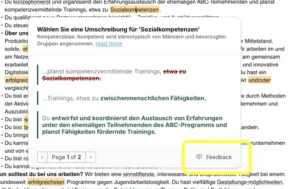
Use the Feedback button in the pop-up if:
- You disagree with a highlight.
- You don’t understand why a term is biased.
- The suggested alternatives don’t fit.
Gendered language settings (Admins only)
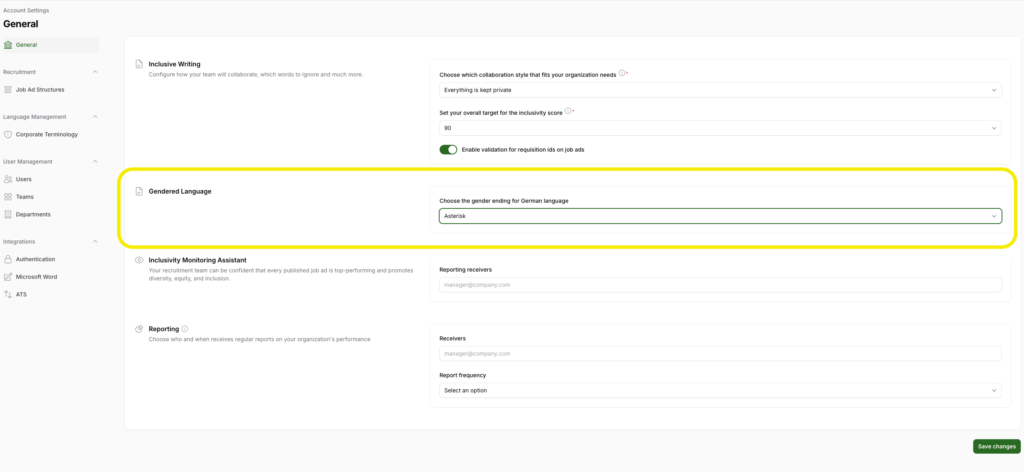
To align the alternatives we offer with your preferred gendered ending, you can change the settings for ‘Gendered Language’:
- Click on your profile icon in the upper right corner.
- Select Account Settings.
- Scroll to Inclusive Writing and find Gendered Language.
- Choose your preferred gendered ending for words referring to people (read more below).
- Save changes.
Gendered language options
You can choose from these formats:
- Double Forms: Uses both male and female versions, e.g., “Mitarbeiter und Mitarbeiterinnen” (female and male co-workers).
- Slash (/) Format: Adds both versions with a slash, e.g., “Mitarbeiter/innen” and “Mitarbeiter/-innen”.
- Asterisk (*) Format: Uses an asterisk, e.g., “Mitarbeiter*innen”.
- Underscore (_) Format: Similar to the asterisk, e.g., “Mitarbeiter_innen”.
- Colon (:) Format: Similar to the asterisk and underscore, e.g., “Mitarbeiter:innen”.
- Binnen-I: Capitalizes “I” to include both genders, e.g., “MitarbeiterInnen”.
- Brackets (): Lists both versions with brackets, e.g., “ein(e) Mitarbeiter(in)”.
- gn: adds the typographical symbol (gn), e.g. “Mitarbeiter (gn)”
- m/w/d: adds the short version of männlich/weiblich/divers (m/w/d), e.g. “Mitarbeiter (m/w/d)”
Thank you for helping us improve inclusive language in German job ads!